
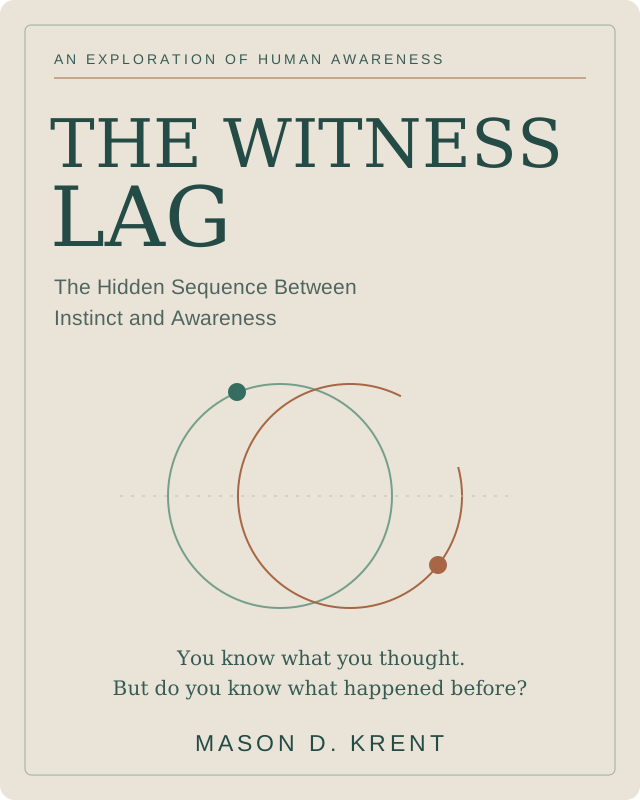
AN EXPLORATION OF HUMAN AWARENESS
The Witness
Lag
The Hidden Sequence Between Instinct and Awareness
You know what you thought. But do you know what happened before?
New here? The illustrated introduction helps you find a comfortable starting point.
THE BOOK · THE QUESTION · THE METHOD
You know what you thought.
But do you know what happened before?
Before you understand why you reacted, something may already have happened. A movement. A sensation. An instinct. A response so immediate that conscious understanding arrives only afterward.
The Witness Lag invites you to question the relationship between what your mind does and what you become aware of it doing. Through observation, psychological inquiry, and a developing framework for examining human responses, Mason D. Krent explores the boundary between instinct and awareness.
The invitation is to recognize patterns that ordinarily pass unnoticed. Understanding your mind may begin with asking what happens before you realize you are thinking.
A POSSIBLE EXPERIENCE TO EXAMINE
A phone buzzes. You reach for it. Then you wonder why.
“I noticed my hand moving toward the phone.”
“I became aware of an urge to check it.”
“Was it the sound, expectation, habit, or something else?”
Invented illustration. These are prompts for reflection, not measured stages or a universal order. A remembered sequence does not establish the timing of brain activity.
What “The Witness Lag” means here
The name identifies the author’s proposed observational framework: notice a response, describe what you became aware of, and examine the explanation you give it. There is no single measured delay asserted here. Observations, hypotheses, competing explanations, and open questions stay distinct.
This site introduces the book’s direction and houses its research companions. The existing Concrete and Abstract manuscripts explore a wider range of subjects; those findings do not, by themselves, establish this framework. A new, complete awareness-focused manuscript is still to be developed.
Start with an everyday experience.
Compare the evidence and alternatives.
Return to your experience with a better question.
A developing author-led collection about awareness, perception, decision-making, and the limits of interpretation. Future volumes are possibilities, not completed books.
EL LIBRO · LA PREGUNTA · EL MÉTODO · BORRADOR
Sabes lo que pensaste.
¿Pero sabes qué ocurrió antes?
The Witness Lag, de Mason D. Krent, explora la relación entre una respuesta, lo que advertimos de ella y la explicación que le damos.
La invitación es reconocer patrones que suelen pasar desapercibidos. El marco observacional propuesto distingue observaciones, hipótesis, explicaciones alternativas y preguntas abiertas.
Un ejemplo para reflexionar
El teléfono vibra. Notas que tu mano se acerca. Te preguntas si influyeron el sonido, una expectativa, la costumbre u otra cosa.
Es un ejemplo inventado. No establece etapas universales, un retraso medido ni cuándo empezó la actividad cerebral. Recordar una secuencia no permite medirla por sí solo.
Estado del proyecto
Esta es la nueva dirección del libro. El manuscrito completo centrado en la conciencia aún está por desarrollar. Los manuscritos Concreto y Abstracto conservan su texto original en inglés y abarcan una investigación más amplia; sus hallazgos no establecen por sí solos este marco.
ONE SMALL STEP AT A TIME
You do not have to understand everything at once.
Pick one question. We will help you find the idea, the evidence, and the next step.
with room for both.
FIND YOUR THREAD
What are you curious about?
Your search stays in this browser.
THE WITNESS LAG · RESEARCH COMPANIONS
Two ways of seeing.
One standard of evidence.
The Concrete edition asks what the record supports. The Abstract edition explores what an idea might mean. Switch perspectives, compare them, or read either book from beginning to end.
Show me the evidence.
Documents, observations, numbers, controls, sources, and the open work.
Read the full edition →ABSTRACT · RESEARCH COMPANIONHelp me see the meaning.
Questions, metaphors, patterns, and the space between curiosity and certainty.
Read the full edition →These original research companions retain their earlier titles and complete English text, including opening material and appendices, retrieved November 15, 2026. Wording and original evidence labels are preserved. Dated source notes below distinguish fresh checks from the manuscript baseline. The full books have not been translated into Spanish.
A MAP BETWEEN THE EDITIONS
Choose the idea,
then choose your way in.
Chapter numbers differ between editions. These links follow the subject, so you can compare the passages that belong together.
YOUR READING ROOM
Open a chapter.
Before the full chapter
The idea, in everyday words.
Your private chapter note
Saved on this device and this website address. Not submitted or synced. Clearing browser data can remove notes.
WIDER RESEARCH ARCHIVE · NUMBERS IN CONTEXT
A number means more
when you know what it counts.
Measurements, catalogue counts, archive IDs, and model inputs play different roles. Each card tells you which kind you are looking at and where it comes from.
TRY THE LOGIC · ILLUSTRATIVE INPUTS
Why reversing both switches can hide the answer.
In the manuscript’s model, reversing both signs leaves their product unchanged. Vary each switch separately and compare the four readings.
Y(s,g) = b + aₛs + a𝗀g + Asg
Choose unitless values. These controls demonstrate algebra; they contain no physical experimental data.
| State (s,g) | Product sg | Y |
|---|
Recovered interaction C =
C = [Y(+,+) − Y(+,−) − Y(−,+) + Y(−,−)] / 4
In this ideal model C equals A. An unmodelled confounder proportional to sg would appear in the same channel. Isolation alone does not identify a new force.
FOLLOW THE TRAIL
The source belongs
beside the statement.
Original manuscript references are retained as A1–A4 and W1–W11. W12 adds a checked source for the MAL example. Checks dated November 15, 2026 establish only the particular statements described here.
A MAP YOU CAN EXAMINE
How the work connects.
THE WIDER SOLNYX COLLECTION
Different rooms.
A shared curiosity.
A directory across the work: research, software, music, games, art, learning, and practical builds. Open public material where it exists; project overviews show where the rest belongs.
Public selection: two complete manuscripts, selected research records, and project overviews. Athena’s full searchable working archive, private conversations, personal administration, and unreleased source files remain private. Project connections do not imply a shared scientific mechanism.
Try this with a reader / Probar con un lector
Try this with your first reader.
KEEP THE QUESTION OPEN
Wonder starts the search.
Evidence helps it grow.
Begin with a chapter that catches your attention. Notice what it says, follow the source, and keep the question that comes next.
Back to the books ↑Find a gentler starting point